3 Game-Changing Link Building Case Studies
Most backlinks exist to pass link juice. These didn’t. One drove 30,000 sales. One sends 3,500 visitors a month. One ranked a KD40 keyword for a brand-new site in 2 months. Here is how each campaign worked.
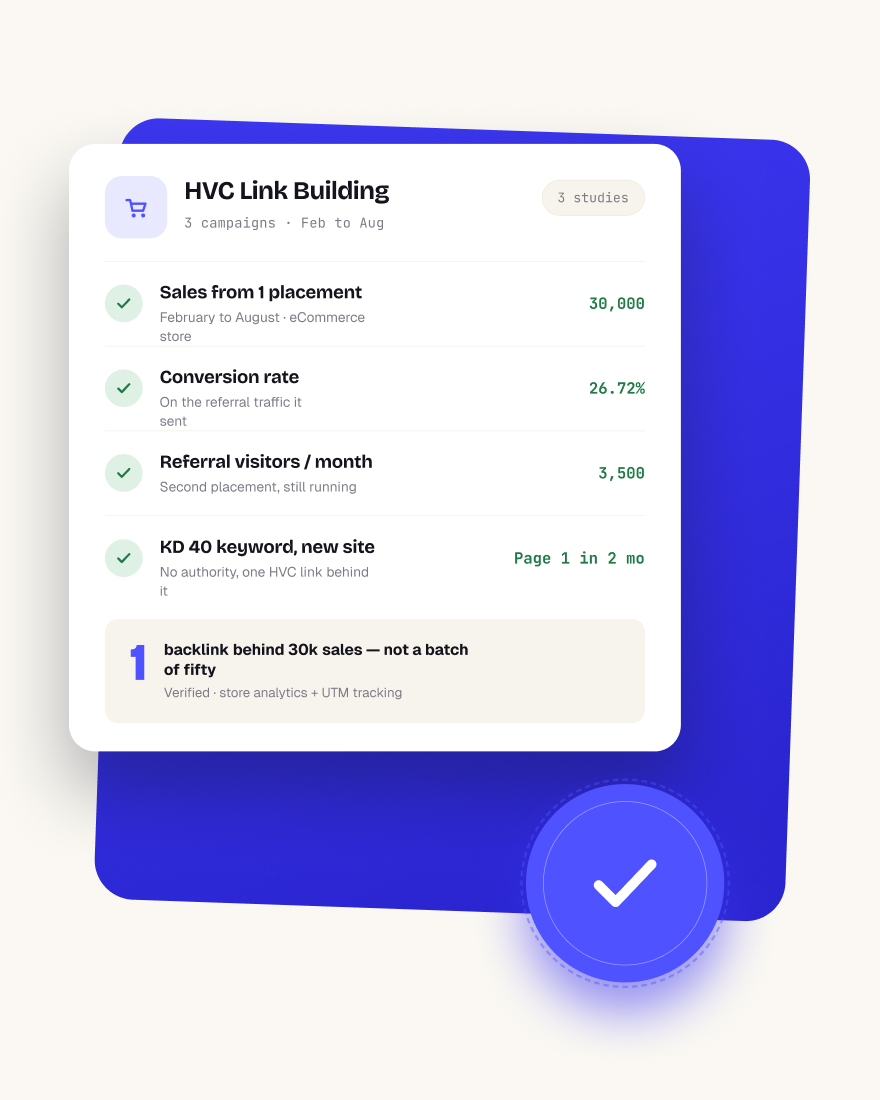
February to August: one placement, 30,000 sales, a 26.72% conversion rate.
From the beginning of SEO, backlinks have been built for one reason: to pass link juice. I wanted them to do more than that. The campaigns below were planned so that every link also brings referral traffic and sales.
I call these HVC (high-value connection) backlinks. A campaign like this has to be strategic and well planned, and I have been testing the method across several websites. The three case studies below show what it produced, and the second half of this page walks through the exact 4-step process so you can run it yourself.
Case Study 1: 30k Sales From Just 1 HVC Backlink
I started this campaign in February. By the end of August, that single placement had driven 30,000 sales for the store. The conversion rate on the referral traffic was 26.72%, which was well above what we planned for.
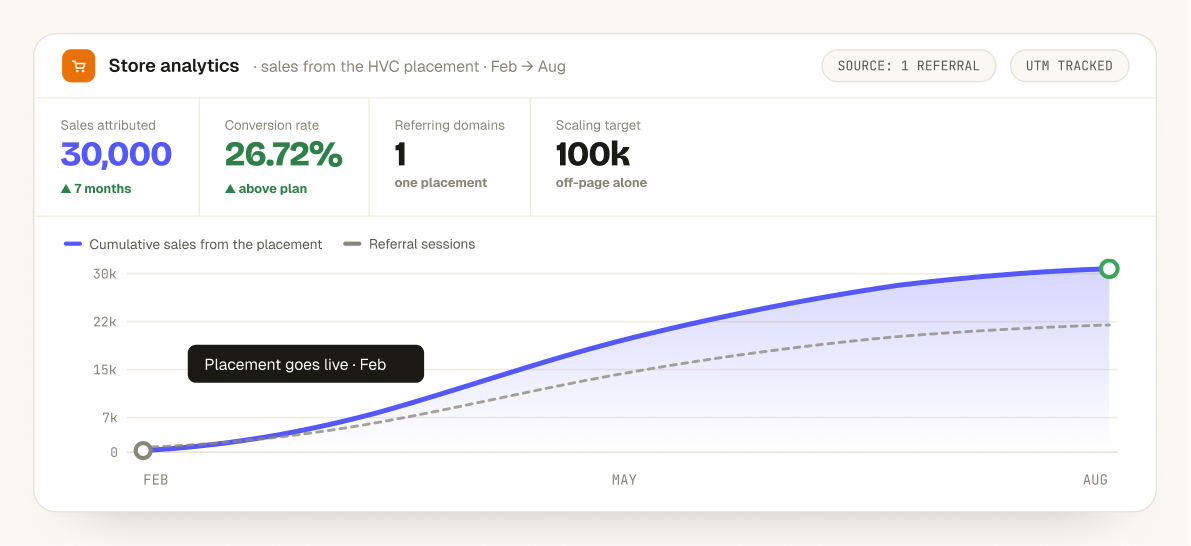
A conversion rate like that from a backlink is not an accident. The placement sat on a page whose readers were already close to buying, and the content was written for them, not for a search engine. We are now scaling the same campaign with a target of 100k sales from off-page alone.
“A backlink should not just pass link juice. Placed on the right page, in front of the right readers, it becomes a sales channel.”
Case Study 2: 3,500 Visitors/Month From 1 Backlink
One placement on a high-traffic page in the client’s niche now sends around 3,500 referral visitors every month. No monthly retainer to a link vendor, no batch of 50 directory links. One well-chosen page, one piece of content the host site wanted, and the traffic keeps arriving month after month.
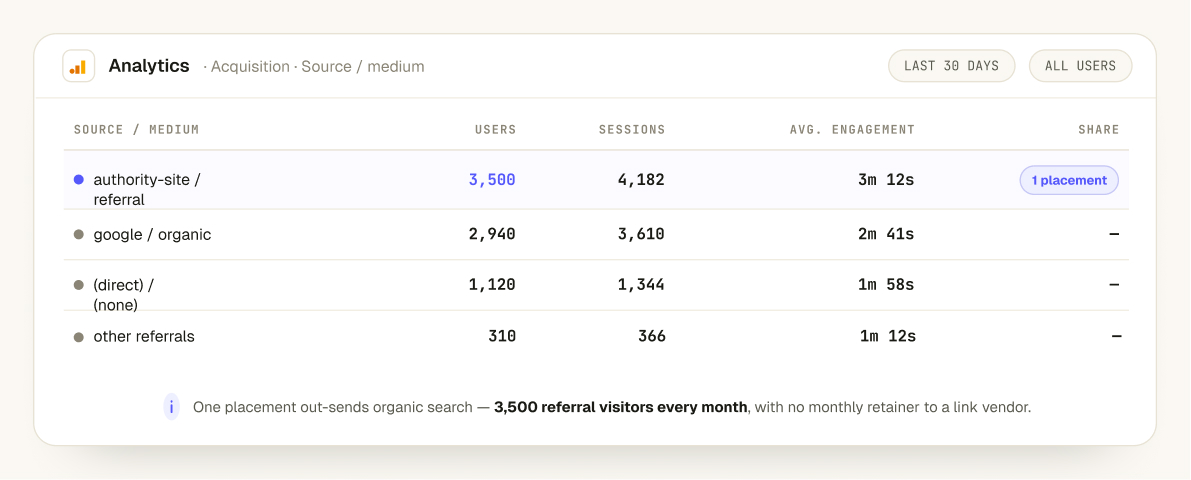
This is the part of the method most link builders skip. Before pitching, I checked what the target page ranks for and how much traffic it holds. The link only counts as HVC if real readers pass through it.
Case Study 3: KD40 Keyword Ranked in 2 Months for a Newborn Website
A brand-new website has no authority, no history, and normally no business ranking for a KD40 keyword. With an HVC backlink from a strong, relevant site behind it, this one ranked in 2 months.
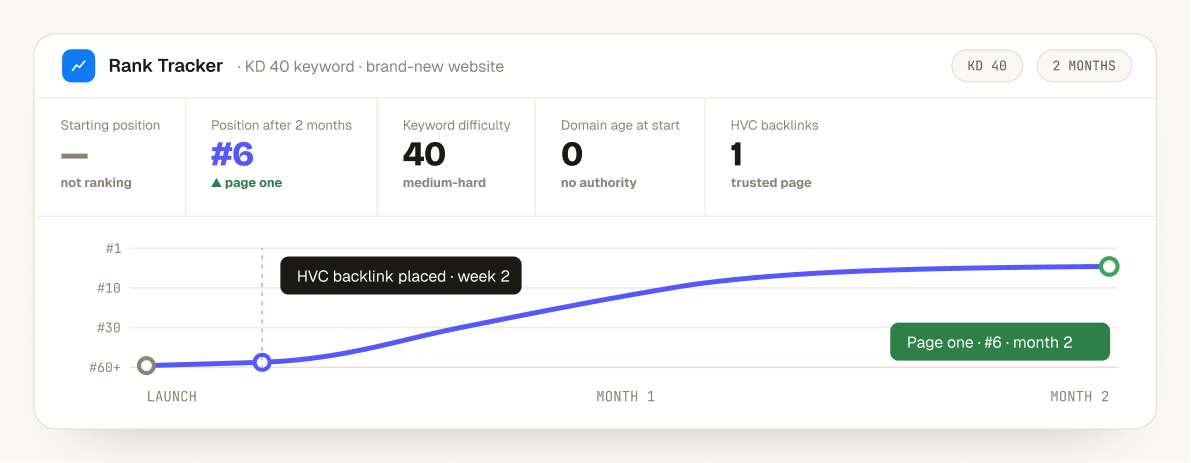
The lesson for new sites: one link from a page Google already trusts, with real traffic behind it, moves rankings faster than dozens of easy links from sites nobody reads.
How To Start an HVC Link-Building Campaign
Here is the exact way I achieved these results. Four steps, in the order we ran them.
1Build an in-depth off-page SEO strategy
An HVC campaign starts with goals, not with a list of sites to email. Our strategy was built on four things:
2Find high-authority sites in your niche
Sourcing sites is not the hard job; finding quality ones is. Once you find a good website, start the outreach carefully. Your message has to be unique. Do not send the generic template you use for buying guest posts. If you have a contact for their advertising department, call or email it directly and say what you want. Ad inquiries get answered fast.
3Offer them the most value
If the value is not there, big sites will reject the offer. If you suspect your proposal can be declined, fix the proposal before you send it. Work out how you are different and why they should pick you. In our campaign we kept the business side quiet and led with value instead. Value can take many forms:
4Build content that will rank #1
Once they agree to publish, write content that converts and ranks #1. We had the niche expertise and resources to write the market’s best piece, and that is the standard. Do not treat it as guest-post filler. This is the content that carries your traffic and sales, and a link that passes real traffic is exactly the kind Google gives actual value to.
+Bonus tip: set up proper tracking
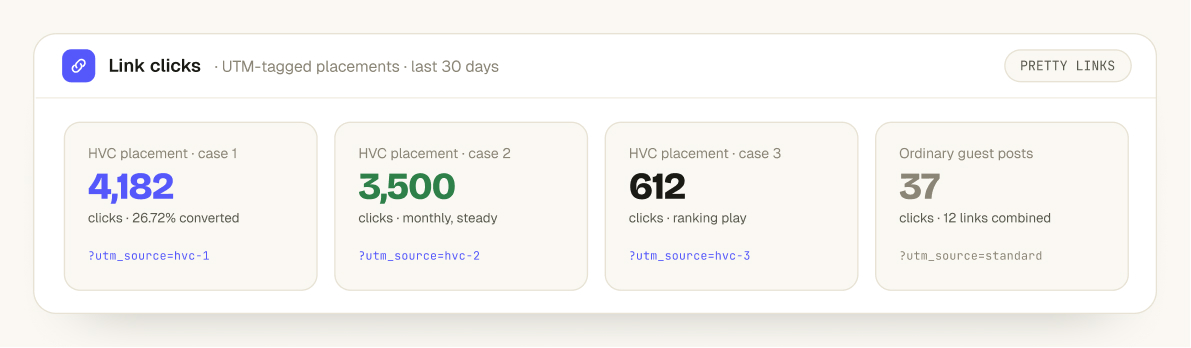
Use UTM parameters on every placed link so you can see exactly how much traffic each placement sends. If your site has goals set up in Google Analytics, you will also see the sales each link produced. On WordPress, a tool like Pretty Links lets you A/B test the destination, since you can change the target URL at any time.
Key Takeaways
- 1 One HVC backlink can outperform hundreds of ordinary ones. A single placement drove 30,000 sales at a 26.72% conversion rate. Judge links by the traffic and revenue they pass, not the count.
- 2 Give before you ask. I sent the target sites business first and asked for the favor later. Without that connection, this campaign does not work.
- 3 Make the offer impossible to reject. Partnership, paid article, recurring fees, or a high-traffic content opportunity. Big sites say yes when the benefit is equal.
- 4 Track every link like a campaign. UTMs and analytics goals tell you which placements bring sales, so you know exactly what to scale.